


Why Do Natural Materials Make Homes Feel More Grounded?
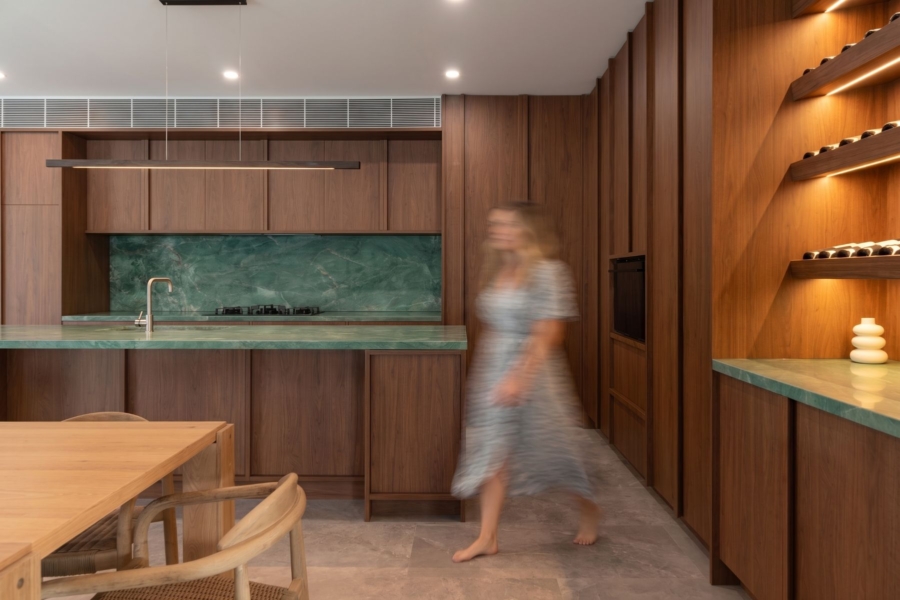
Thoughtfully chosen materials have the power to transform a house into a home that feels calm, welcoming, and timeless. By combining authentic textures, soft natural tones, and durable surfaces, modern interiors achieve a sense of balance that lasts beyond changing design trends.
This is why natural materials make homes feel more grounded. Materials such as stone-look tiles, natural stone, timber, and matte porcelain tiles bring warmth, depth, and architectural character to every space. At Showtile, you’ll find carefully curated collections that help homeowners, architects, and designers create interiors with lasting style and functionality.
Why Do Natural Materials Create a Calmer Interior?
Natural materials create calm because they introduce depth without excessive visual noise.
A completely uniform surface can sometimes feel flat, particularly in a large room with limited architectural detail. By comparison, natural material variation gives the eye something subtle to follow.
Stone carries veining and mineral movement. Timber contains grain and directional rhythm. Clay introduces warmth and tonal differences. A textured tile creates small areas of light and shadow.
These details make an interior feel layered while allowing the overall palette to remain restrained.
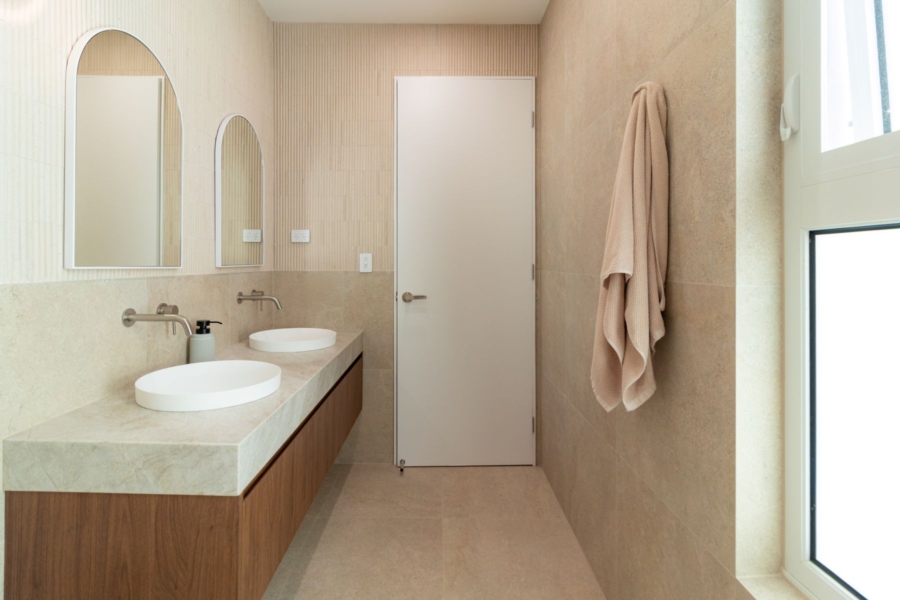
Natural materials can help establish:
- Visual softness within contemporary architecture
- Tonal variation without dominant patterns
- A stronger connection between surfaces and natural light
- Greater material depth in neutral interiors
- A more stable foundation for furniture and artwork
- Warmth within minimal or highly structured spaces
A limestone-inspired floor, for example, can make an open-plan living area feel more settled. A matt mineral-toned wall tile can soften reflection in a bathroom, while a handmade-inspired ceramic splashback can bring controlled movement into a kitchen.
The result is not necessarily traditional. Many premium interiors use natural references within precise, minimal compositions.
How Do Natural Materials Affect the Way a Room Feels?
The effect comes from the relationship between colour, variation, texture and scale.
| Material or surface | Visual quality | Spatial effect | Suitable applications |
| Natural stone | Veining and mineral variation | Adds weight and permanence | Floors, bathrooms, entries and fireplaces |
| Stone-inspired porcelain | Controlled tonal movement | Creates calm and continuity | Open-plan floors, walls and wet areas |
| Timber | Grain and warmth | Softens hard architectural lines | Joinery, floors and feature details |
| Timber-look porcelain | Linear grain with consistent performance | Adds warmth in moisture-prone areas | Bathrooms, kitchens and outdoor zones |
| Clay and terracotta | Warm colour and organic variation | Creates intimacy and tactility | Kitchens, entries and feature floors |
| Textured wall tiles | Shadow and surface relief | Adds depth without loose decoration | Vanities, fireplaces and feature walls |
| Terrazzo surfaces | Aggregate movement | Introduces controlled visual rhythm | Bathrooms, kitchens and commercial areas |
| Matt porcelain | Low reflection and tonal control | Supports visual quietness | Floors, walls and large connected areas |
No material works in isolation. The way it feels depends on its relationship with adjoining paint, joinery, metal finishes, lighting and furniture.
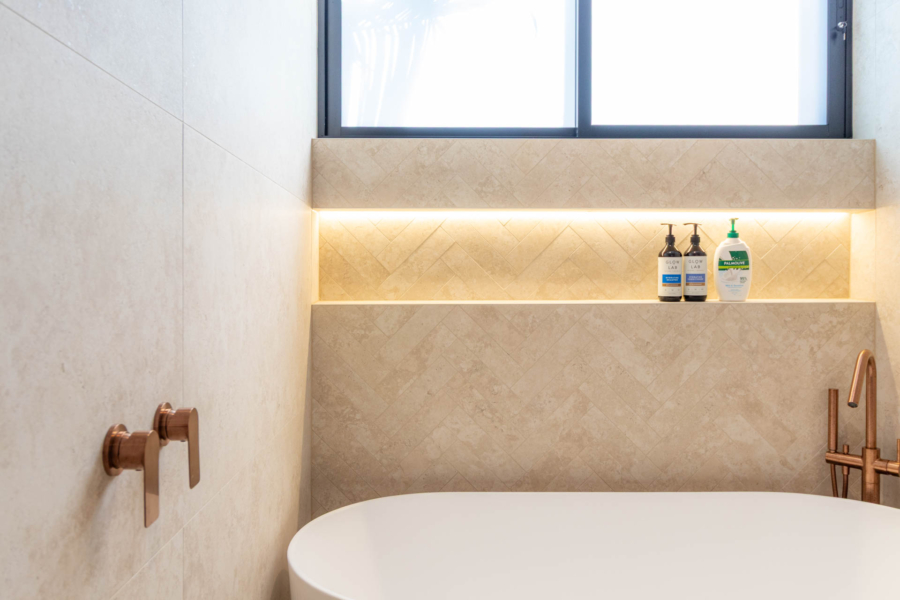
A heavily veined surface may require quieter supporting materials. A plain floor can accommodate a more tactile wall, while a strongly textured splashback may work best beside a restrained benchtop.
Why Does Texture Give a Room More Physical Presence?
A grounded interior is not only understood visually. It is also experienced through proximity and touch.
Surface texture changes how light moves across a wall or floor. Smooth and polished finishes reflect light more directly, creating a crisp or formal effect. Matt and honed finishes diffuse reflection and often feel quieter.
Fluted, ribbed, brushed or stone-textured tiles produce small shadows that change as daylight moves through the room.
This can give simple architecture greater presence without requiring additional decoration.
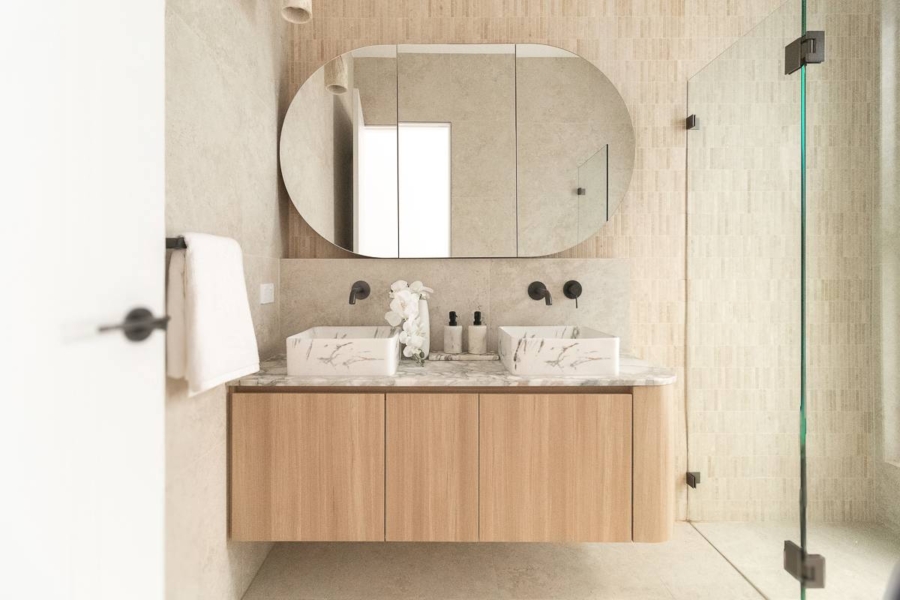
A textured surface may be used to:
- Define the wall behind a vanity
- Create depth around a fireplace
- Add tactility to a bath surround
- Give a kitchen splashback more character
- Highlight a reception counter or bar
- Introduce shadow into a neutral interior
- Create a transition between adjoining zones
Texture should be controlled rather than applied to every plane.
When several highly expressive surfaces appear together, the room can lose its visual hierarchy. The strongest schemes often allow one tactile material to lead while the surrounding finishes remain simpler.
Why Do Stone Surfaces Feel Permanent?
Stone communicates permanence through its visual weight, geological formation and natural variation.
Marble, limestone, travertine, sandstone and slate each contain characteristics associated with time and place. Veins, fossils, tonal shifts and mineral marks prevent the material from feeling manufactured or temporary.
Showtile’s natural stone tile collection includes materials intended for walls, floors and architectural features where authentic mineral character is important.
Natural stone tiles are often selected for:
- Entrance floors
- Bathroom walls and vanities
- Fireplace surrounds
- Feature walls
- Courtyards and garden paths
- Pool surrounds
- Hospitality interiors
- Transitional indoor-outdoor areas
Natural stone can become more expressive over time, but its use requires careful specification. Porosity, sealing, maintenance, thickness, surface finish and slip resistance should all be evaluated according to the application.
Its visual irregularity is part of the appeal, but designers must decide how much variation the broader material palette can accommodate.
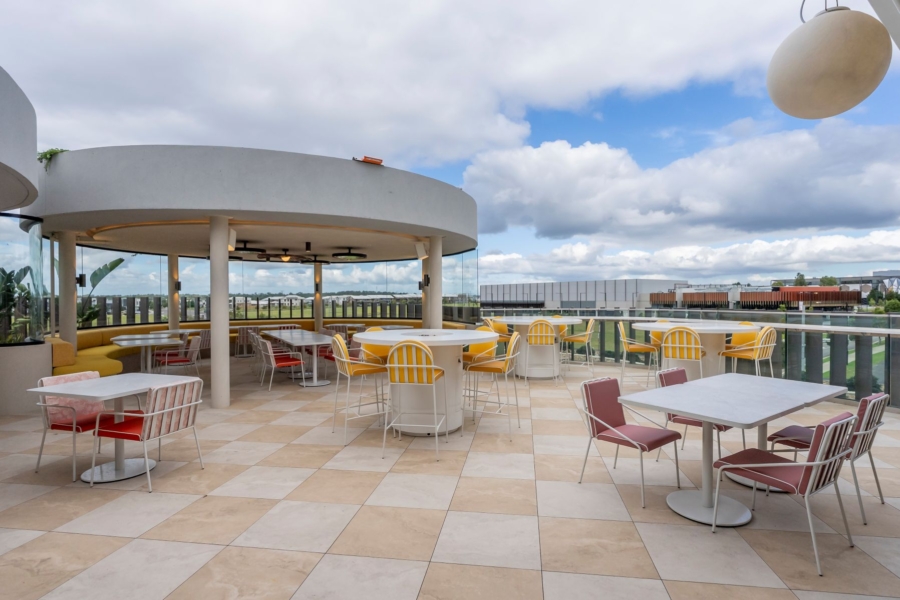
How Do Stone-Look Tiles Create a Grounded Effect?
Stone look tiles reproduce the tonal movement and mineral character of natural surfaces in a more controlled porcelain format. They are useful when a project requires continuity across larger walls or floors, predictable technical performance or reduced maintenance. Showtile’s stone look tile collection includes designs inspired by limestone, travertine, marble, sandstone and slate. The collection is positioned for architects, designers and builders seeking natural warmth with greater consistency across a project.
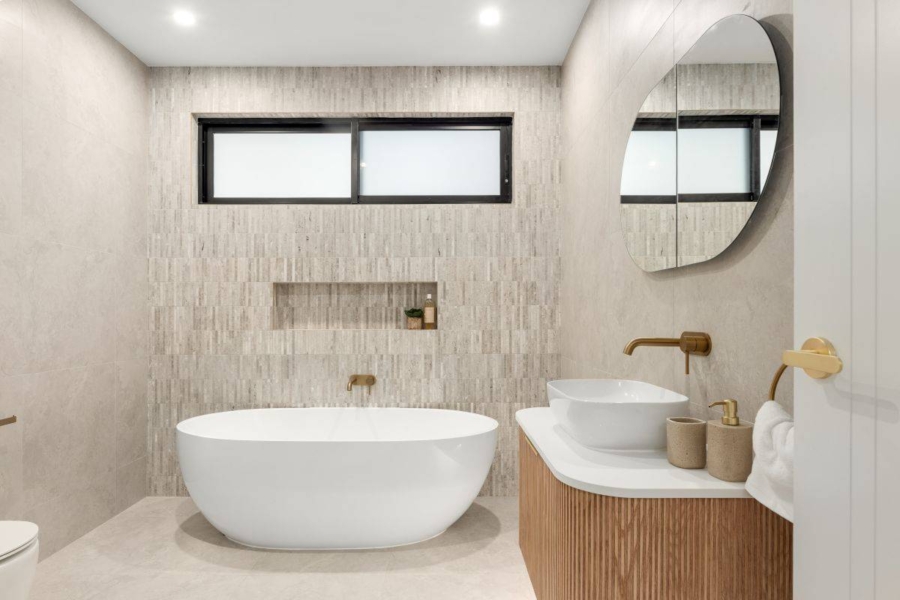
These surfaces can support grounded interiors by providing:
- Restrained veining
- Controlled colour variation
- Matt or honed-inspired finishes
- Large-format dimensions
- Coordinating indoor and outdoor options
- Fewer visible changes between adjoining rooms
- Greater moisture resistance than many porous materials
A large-format limestone-inspired tile may continue from a hallway into a kitchen and living area, reducing visual interruptions. In a bathroom, the same visual language can wrap from the floor onto the walls to create a cohesive envelope.
The most convincing stone-inspired surfaces tend to support the architecture rather than dominate it.
When Should Porcelain Be Used Instead of Natural Stone?
The decision depends on the desired balance between individuality and control.
Natural stone provides singularity. Each section may display different markings, veins and tonal changes. Porcelain offers greater consistency in size, finish and pattern distribution.
| Project requirement | Natural stone | Porcelain alternative |
| Unique geological character | Highly suitable | Reproduced in a controlled design |
| Consistent appearance across large areas | More variable | More predictable |
| Low water absorption | Depends on stone type | Generally strong performance |
| Reduced maintenance | May require sealing | Usually easier to maintain |
| Large-format continuity | Available with limitations | Broad range of formats |
| Material authenticity | Genuine natural material | Nature-inspired manufactured surface |
| Controlled replacement | Batch matching can be difficult | Usually easier to coordinate |
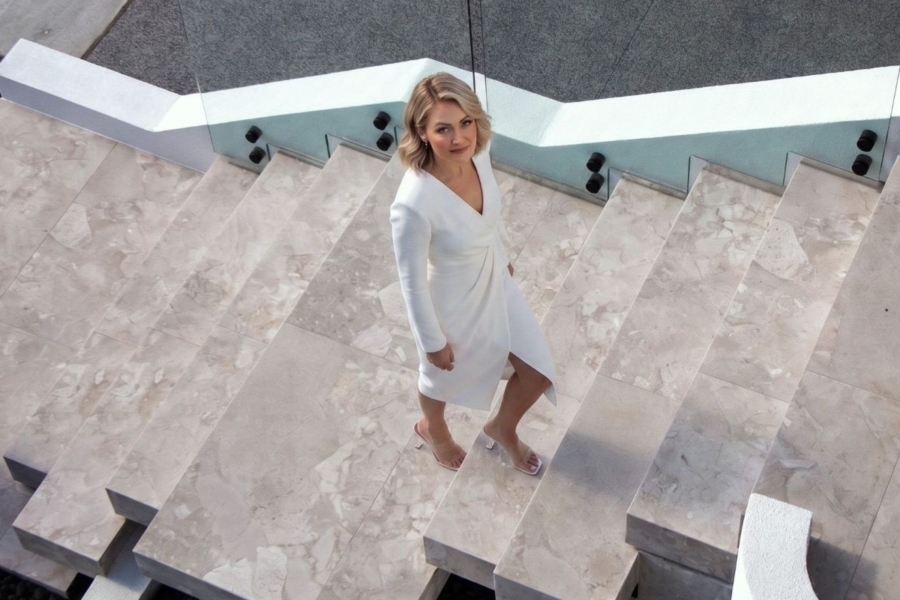
Showtile’s porcelain tile collection includes stone-, timber- and terrazzo-inspired designs selected for durability, finish consistency and integration with other architectural materials.
Neither option is universally better. The appropriate surface is the one that supports the project’s light, use, maintenance requirements and overall material strategy.
How Do Large-Format Tiles Make Interiors Feel More Settled?
Large-format surfaces reduce the number of interruptions across a floor or wall. Every grout line creates a visual division. When formats become larger, the surface can be read as a broader plane rather than a grid of separate pieces. This makes large-format porcelain tiles particularly useful in interiors designed around clarity and continuity.
Showtile’s porcelain slab collection includes oversized surfaces inspired by marble, travertine, limestone and other natural stones. These slabs are intended for bathrooms, kitchens, feature walls and other applications where reduced grout lines and material realism are important.
Large formats can help:
- Make open-plan areas feel more connected
- Reduce visual fragmentation
- Emphasise architectural proportion
- Create continuous bathroom envelopes
- Give fireplace surrounds a monolithic quality
- Allow subtle veining to appear at a broader scale
- Support a cleaner relationship between floors and joinery
The layout still requires careful planning. Tile dimensions, room proportions, grout width and cut positions all influence whether the finished surface appears calm or awkward.
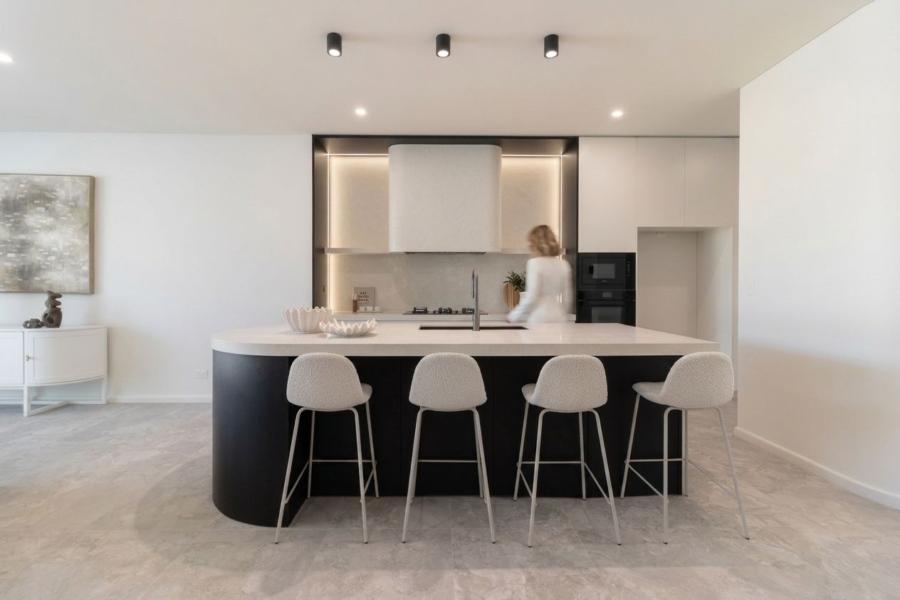
Why Do Matt and Honed Finishes Feel More Natural?
Matt tiles and honed surfaces reflect less direct light than highly polished finishes.
This softer interaction with light can reduce glare and allow colour variation to appear more gradually. It is one reason these finishes are often used in bathrooms, living areas and minimal interiors.
A matt limestone tone can feel soft and understated. A honed stone surface retains material richness without the formal reflection associated with polished marble.
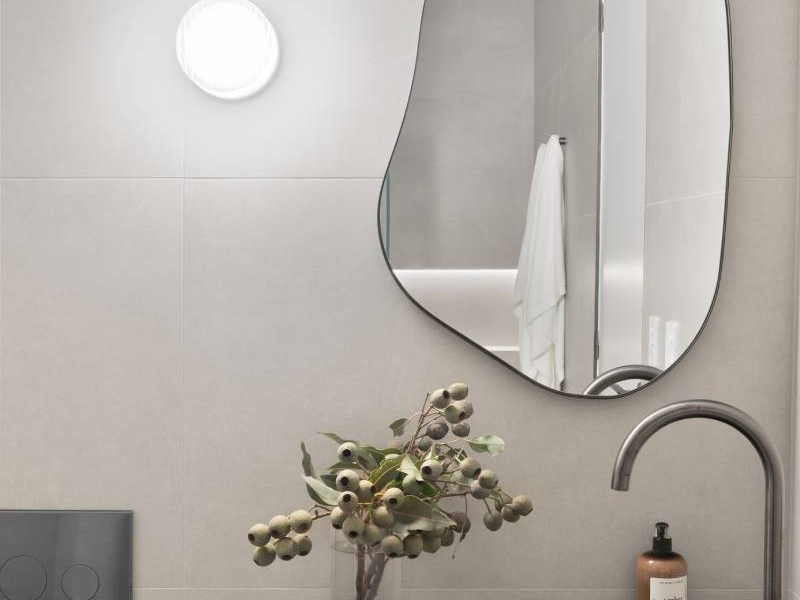
Finish selection should be based on both atmosphere and function.
Designers should consider:
- The direction and intensity of natural light
- Artificial lighting placement
- Expected foot traffic
- Wet-area requirements
- Cleaning and maintenance
- The desired degree of reflection
- The relationship with metal and glass finishes
Polished materials can still work within grounded interiors, but they are usually most effective when reflection has a clear purpose, such as adding light to a dark wall or giving a limited feature area greater emphasis.
How Can Timber Add Warmth to Hard Surfaces?
Timber creates warmth through colour, grain and directional movement. When used beside stone, porcelain, plaster or concrete, timber can soften hard architectural planes and introduce a more human scale. However, natural timber may not suit every area, particularly where water, humidity or intensive cleaning are concerns.
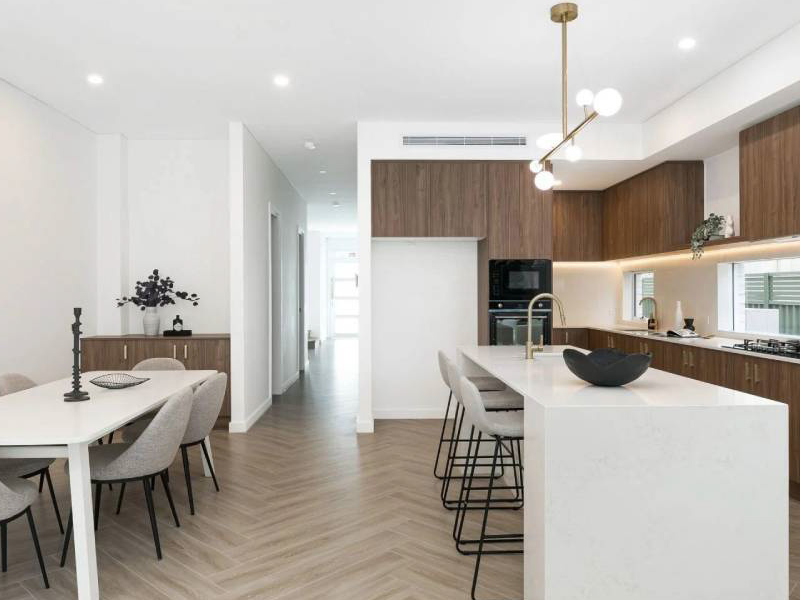
Showtile’s timber look tile collection recreates the grain and plank format of wood in porcelain. These tiles can be used across bathrooms, kitchens, living zones and selected outdoor areas while offering greater moisture resistance and dimensional stability than natural wood.
Timber look tiles can be used to:
- Warm a stone-led bathroom
- Create directional movement in a hallway
- Connect indoor rooms with an alfresco area
- Add texture to a fireplace wall
- Introduce a spa-like quality to wet areas
- Offset grey or concrete-inspired palettes
Layout affects the result. Straight plank arrangements create calm direction, while herringbone and chevron patterns add more rhythm and visual activity.
Why Do Bathrooms Benefit From Natural Restraint?
Bathrooms contain fewer loose furnishings than most other rooms, so their surfaces carry more responsibility.
Tiles, stone, mirrors, glass, joinery and fittings establish almost the entire visual composition. A poorly balanced surface palette can make the room feel cold, crowded or fragmented.
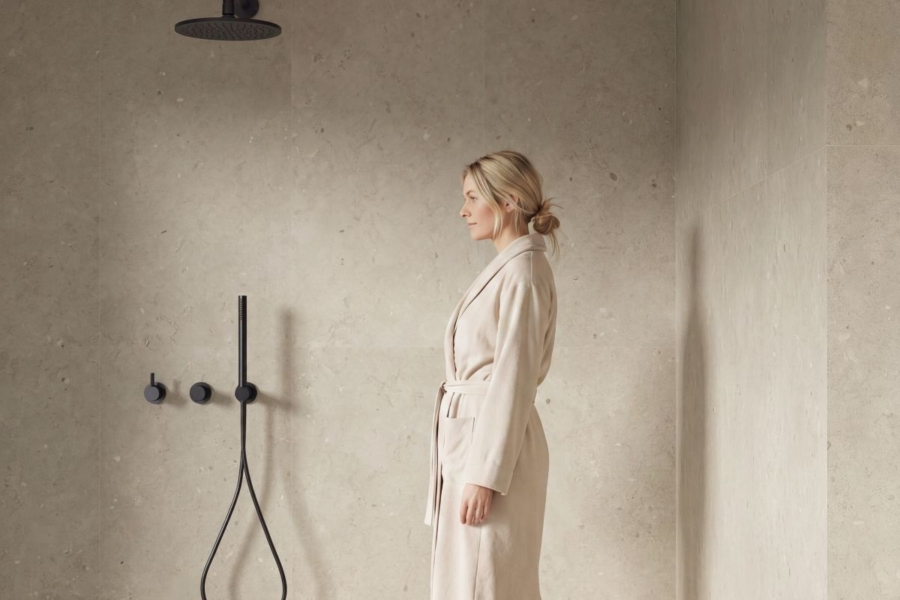
A grounded bathroom usually uses a limited material hierarchy.
For example:
- A principal bathroom tile defines the floor and main walls.
- A secondary surface adds texture behind the bath or vanity.
- A mosaic provides grip or smaller-scale detail.
- Joinery introduces warmth.
- Metal finishes add controlled contrast.
Soft limestone shades, warm whites, muted clay tones and mineral greys can help the room feel settled without becoming visually empty.
Continuity is often effective in compact ensuites. Using related colours across the floor and walls reduces contrast and can make the space feel more generous.
Powder rooms can support a stronger surface because they are smaller and used for shorter periods. A deep green wall tile or sculptural texture can create intimacy, provided the remaining elements are restrained.
How Can Kitchens Use Natural Materiality Without Feeling Busy?
A kitchen feels grounded when the floor, benchtop, splashback and joinery work as one composition.
Each surface should have a clear role:
- The floor creates the visual base.
- The benchtop provides tactility and function.
- The splashback connects the working wall.
- Joinery introduces colour, grain or structure.
- Metal finishes provide detail and contrast.
A stone-inspired porcelain floor can anchor cabinetry and furniture. A ceramic splashback may introduce gentle movement, while a timber finish can soften the harder surfaces.
The kitchen should not depend on one dramatic material to create the entire design.
When the benchtop contains strong veining, a simpler splashback may provide balance. When the splashback is textured or irregular, a quieter floor can prevent the room from becoming visually crowded.
Can Terrazzo Create Natural Movement?
Terrazzo introduces movement through pieces of stone, quartz, marble or glass distributed within a binder.
The variation resembles natural aggregate and can give a room visual energy without relying on a repeated decorative motif.
Showtile’s terrazzo and terrazzo-look tile collection includes surfaces for residential, hospitality, commercial and selected outdoor applications.
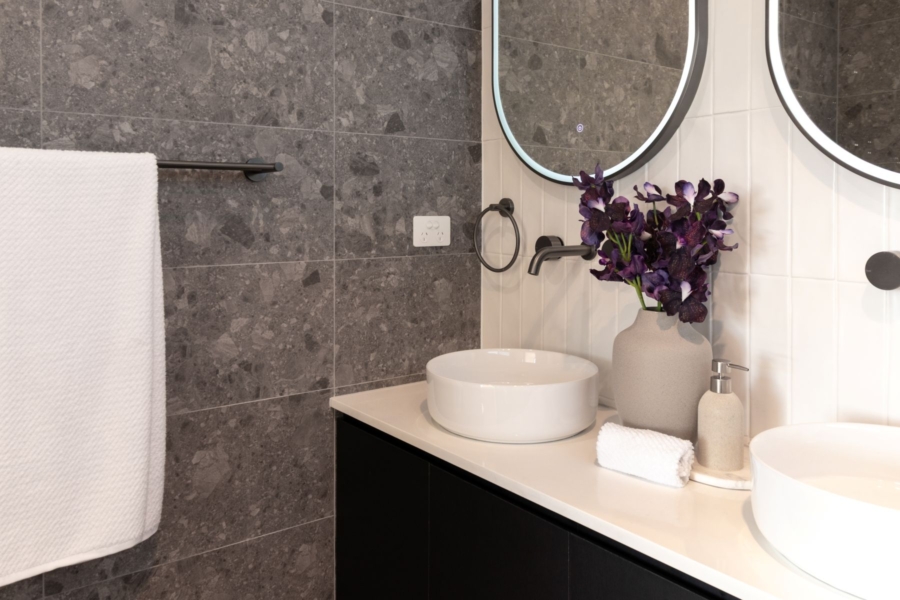
Terrazzo tiles work well when paired with quieter materials such as:
- Plain matt wall tiles
- Natural timber joinery
- Tonal grout
- Simple painted surfaces
- Restrained metal finishes
- Solid-colour benchtops
Aggregate scale matters. Fine chips create a more uniform reading, while larger fragments produce stronger movement and may become the dominant surface within the room.
How Do Designers Keep Natural Materials Refined?
Designers control natural materiality through hierarchy, proportion and repetition.
Rather than combining many expressive finishes, they identify which surface should lead and which materials should provide support.
A refined specification usually considers:
- Material hierarchy: deciding which surface carries the most movement
- Undertone: coordinating warm, neutral or cool colours
- Format: balancing large planes with smaller details
- Finish: selecting reflection according to light and function
- Texture: using relief where shadow can reveal it
- Grout colour: supporting continuity or creating intentional contrast
- Set-out: aligning cuts, edges and joints with architectural features
- Transition: planning how one surface meets another
- Performance: matching porosity and slip resistance to the location
Grout is particularly important. A tonal grout can allow a stone-inspired tile to read as one surface. Strongly contrasting grout creates a more graphic result and may reduce the sense of material continuity.
Which Showtile Collections Support a Natural Material Palette?
Showtile organises its broader range into material and application-led categories, including porcelain slabs, stone look, concrete look, terrazzo, timber look, natural stone, terracotta, mosaics and wall cladding.
Relevant collections include:
All Showtile Collections for comparing colours, formats and surface types
- Natural Stone Tiles for authentic mineral variation
- Stone Look Tiles for controlled stone-inspired surfaces
- Timber Look Tiles for warmth and linear grain
- Porcelain Slabs for expansive walls and reduced grout lines
- Terrazzo and Terrazzo Look Tiles for aggregate movement
- Porcelain Tiles for durable, coordinated applications
- Non-Slip Tiles for wet and exterior zones requiring additional grip
- All Showtile Collections for comparing colours, formats and surface types
How Should Samples Be Evaluated Before Specification?
A tile sample should be assessed within the actual material environment rather than viewed alone.
Natural and nature-inspired surfaces change under different lighting conditions. A warm beige may appear cooler beside grey joinery, while subtle veining can become more noticeable across a full wall.
Before making a final selection:
- View samples in natural and artificial light.
- Place them beside paint, joinery and benchtop materials.
- Compare several pieces to understand variation.
- Review grout colours alongside the surface.
- Check the format against room dimensions.
- Confirm technical suitability for the intended area.
- Consider how the surface will meet adjoining floors and walls.
- Review matt, honed and textured finishes at different angles.
This process helps ensure the material feels connected to the architecture rather than added after the design has already been resolved.
How Can Natural Materials Create Long-Term Clarity?
Natural materiality gives an interior stability because it is based on texture, proportion and material relationships rather than temporary styling.
Stone, timber, clay and mineral-inspired porcelain can create spaces that feel warm without becoming decorative, minimal without feeling empty and contemporary without appearing disposable.
The most successful interiors use these materials with restraint. One surface may carry movement, another provides warmth and the remaining finishes allow both to breathe.
Showtile’s curated collections give architects, designers, builders and homeowners access to natural and nature-inspired surfaces across multiple formats and applications.
To compare materials or request architectural samples, explore the Showtile collection, email sales@showtile.com.au or call (02) 9709 5836.



