


Modern Bathroom Tiles Design: How to Create a Balanced Contemporary Space
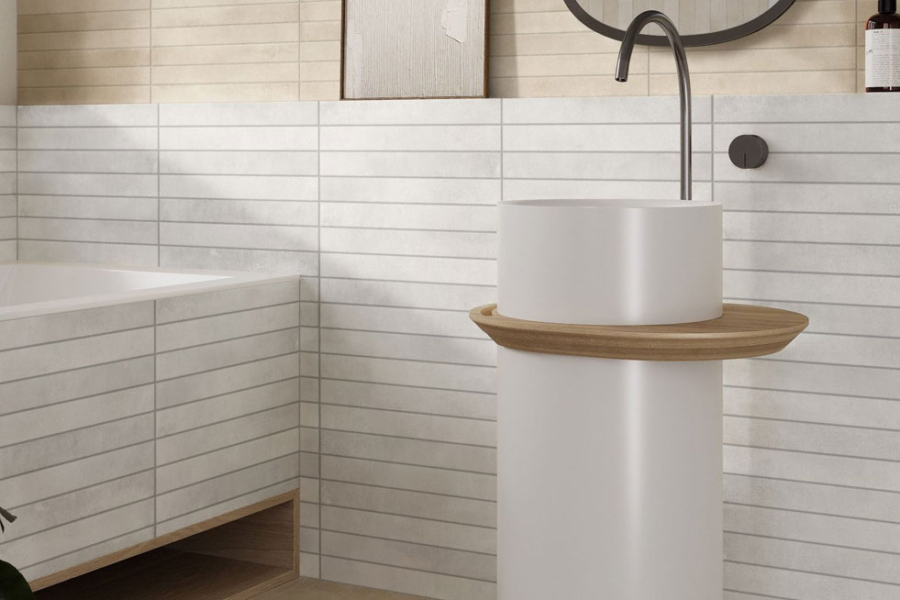
A successful modern bathroom tiles design begins with the way surfaces relate to the room as a whole. Proportion, tile layout, lighting, grout and the transition between wet and dry zones all influence whether the space feels calm, intentional and visually connected. Showtile helps homeowners, designers and builders approach bathroom design with a stronger focus on material balance, spatial flow and long-term visual consistency.
What Makes a Bathroom Tile Scheme Feel Truly Modern?
Modern bathroom design depends more on proportion, restraint and material consistency than on one particular tile style. Large-format porcelain, marble-look surfaces and textured accents can all feel contemporary when the visual hierarchy is clear and each material has a specific role.
Why Does Visual Hierarchy Matter in a Bathroom?
A bathroom becomes easier to read when one surface establishes the main visual language.
That primary material can cover most of the floor and walls, while a second surface introduces texture or stronger movement around the vanity, bath or shower. A third accent may be added at a smaller scale if the room needs extra detail.
A useful hierarchy is:
- Main architectural tile for continuity
- Secondary texture for depth
- Controlled accent for contrast
When every wall competes for attention, even premium finishes can lose impact.
How Many Tile Types Should a Modern Bathroom Use?
There is no fixed number, but two or three coordinated expressions are often enough for a refined bathroom.
For example, a stone-look porcelain can define the floor and main walls, a textured version of the same collection can highlight one wall, and a small mosaic can be used inside a niche or shower floor.
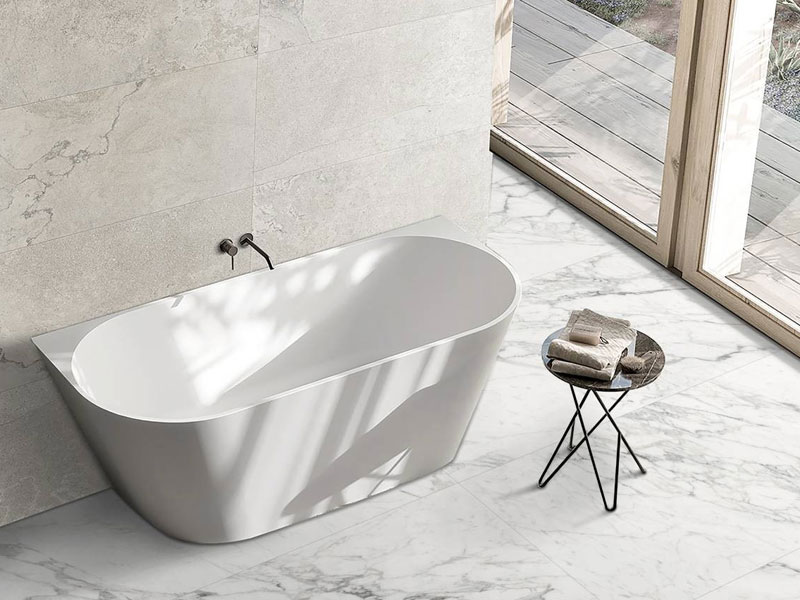
Modern tiles create a calm, balanced bathroom
The important point is that every surface should relate through colour, material character or scale.
How Can Repetition Make a Bathroom Feel More Refined?
Repeating one tile across several surfaces reduces visual breaks.
The same stone-look material can continue from floor to wall, then change only in finish or texture where more grip or emphasis is needed. This approach gives the bathroom a stronger sense of continuity without making the room feel monotonous.
How Should Modern Bathrooms Be Divided Into Wet and Dry Zones?
Wet and dry zones should influence both tile specification and visual emphasis. Shower floors, bath surrounds and niches need different functional consideration from vanity walls or dry circulation areas, but the zones should still belong to one material scheme.
Which Surfaces Define the Wet Zone?
The wet zone normally includes:
- Shower floor
- Shower walls
- Bath surround
- Shower bench
- Niche
- Areas close to direct water exposure
Grip, drainage geometry and maintenance become particularly important in these locations.
A tile that works beautifully on a vanity wall may not be appropriate for the shower floor, so application suitability should be confirmed rather than assumed.
How Should the Vanity Zone Differ From the Shower?
The vanity zone usually has more freedom for visual expression.
A textured wall tile, stronger veining or a different format can sit behind the mirror and cabinetry while the shower remains more restrained.
This creates contrast without introducing an entirely unrelated material family.
Should the Bath Area Become a Feature Zone?
A freestanding bath can become a natural focal point, but the feature does not need to rely on bold pattern.
Subtle veining, a honed surface, vertical texture or directional lighting can create enough emphasis. A restrained bath wall often feels more architectural than a highly decorative patterned surface.
How Should Floor and Wall Tiles Relate in a Modern Bathroom?
Floor and wall tiles should either continue one material language or create a controlled contrast. The strongest bathrooms avoid abrupt changes that feel disconnected from the architecture.
When Should the Same Tile Continue From Floor to Wall?
This approach works especially well in compact bathrooms and minimalist ensuites.
Pure Stone is suitable for both wall and floor applications and is available in 600×600, 600×1200 and 1200×1200 formats, with a P4 matt finish for the main range.
Using one stone-look material across several planes can make a small room feel calmer because the eye is not interrupted by multiple colour changes.
The same principle of material continuity can also be useful when coordinating other rooms. For example, broader planning around kitchen floor tiles design often works best when flooring is considered in relation to adjacent surfaces rather than as an isolated finish.
When Should Wall Tiles Contrast With the Floor?
Contrast works best when based on texture, sheen or scale instead of unrelated colour.
A matt floor may be paired with a lightly polished wall tile, or a large-format base tile may be combined with a textured feature surface from the same tonal family.
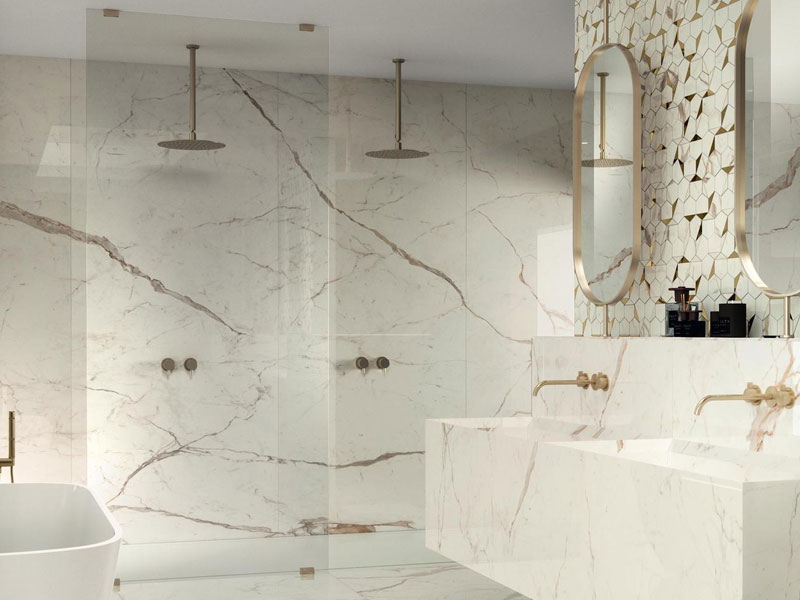
Soft neutral surfaces add warmth and depth
This keeps the bathroom cohesive while giving selected walls more depth.
How Can a Feature Wall Avoid Looking Decorative?
Feature walls should feel integrated with the architecture.
One effective approach is to use a related material with stronger surface relief. Romantic Carrara combines 600×1200 marble-look porcelain with a matching 3D Line textured format, making it possible to move from a calm main surface to a more expressive wall without changing the entire palette.
How Does Tile Scale Change Bathroom Proportion?
Tile size changes how the room is visually divided. Large-format tiles reduce grout frequency and create broader surfaces, while smaller formats increase detail and can define specific zones.
When Do Large-Format Tiles Work Best?
Large-format tiles are particularly effective where the design aims for a quieter, more architectural bathroom.
Fewer visible joints allow stone-look or marble-look movement to read more clearly across the wall or floor.
Large tiles also work well behind a freestanding bath or across long vanity walls where continuous surface character matters.
Can Large Tiles Work in Small Bathrooms?
Yes.
A small bathroom does not automatically require small tiles. Large formats can reduce visual interruption and make the room feel more continuous.
The main consideration is layout. Excessive narrow cuts around corners, cabinetry or the shower can undermine the clean effect that large tiles are meant to create.
Where Do Smaller Formats Work Better?
Smaller formats remain useful where the geometry changes more frequently.
Typical applications include:
- Shower floors
- Niches
- Curved details
- Feature strips
- Small transitional zones
A change in scale can add interest without introducing another colour.
How Should Tile Set-Out Align With Bathroom Joinery?
Tile set-out should respond to vanity edges, shower screens, niches and major architectural lines. Even expensive tiles can look unresolved when grout joints and cuts ignore the structure of the bathroom.
Should Grout Lines Align With the Vanity?
Where practical, yes.
Aligning tile modules with the vanity, mirror or shower screen can make the room feel intentionally planned rather than fitted afterwards.
A consistent grid also reduces awkward fragments at visible edges.
How Should Tiles Meet a Freestanding Bath?
The bath position should be considered before the final set-out is approved.
Centre lines, tile joints and wall symmetry can all influence whether the bath feels properly integrated into the room.
Poorly positioned cuts behind or beside the bath can become visually distracting once the space is complete.
Why Should Tile Planning Happen Before Installation?
Set-out affects:
- Centre lines
- Corners
- Niche placement
- Floor waste
- Shower screen alignment
- Vanity edges
- Visible cuts
A clear plan also helps installers anticipate how larger formats will transition across walls and floors.
How Do Texture and Light Change Bathroom Tiles?
Surface texture becomes more noticeable when light moves across it. Matt finishes, polished surfaces and 3D reliefs respond differently to daylight, wall washers and concealed lighting.
Why Do Matt Tiles Feel Different From Polished Tiles?
Matt surfaces absorb more light and usually create a softer, calmer effect.
Polished surfaces reflect more light and can make veining more pronounced. That can be useful in luxury bathrooms, but the reflective quality should be balanced with cabinetry, mirrors and metal finishes.
T-Marble offers warm and white marble-inspired porcelain with a matt P3 finish in 300×600 and 600×600 formats, giving bathrooms a quieter interpretation of marble.
How Can Directional Lighting Reveal Texture?
Side lighting is especially effective with raised or linear surfaces.
A wall washer can create shadows across 3D porcelain, making the texture visible without introducing more colour.
Aria includes standard stone-look formats and matching 3D Line options, allowing one material family to move between calm surfaces and stronger textured zones.
When Should a Textured Surface Be Used?
Texture works best when concentrated.
Good locations include:
- Vanity wall
- Bath wall
- Shower end wall
- Recessed niche
- Narrow feature plane
Using 3D texture across every wall can reduce the contrast that makes the feature effective.
How Can Colour Be Used Without Making a Bathroom Feel Trend-Driven?
Modern bathrooms tend to age better when colour comes from material tone rather than a highly fashionable palette. Warm stone, soft grey, ivory and restrained marble movement can adapt more easily as tapware, joinery and accessories change.
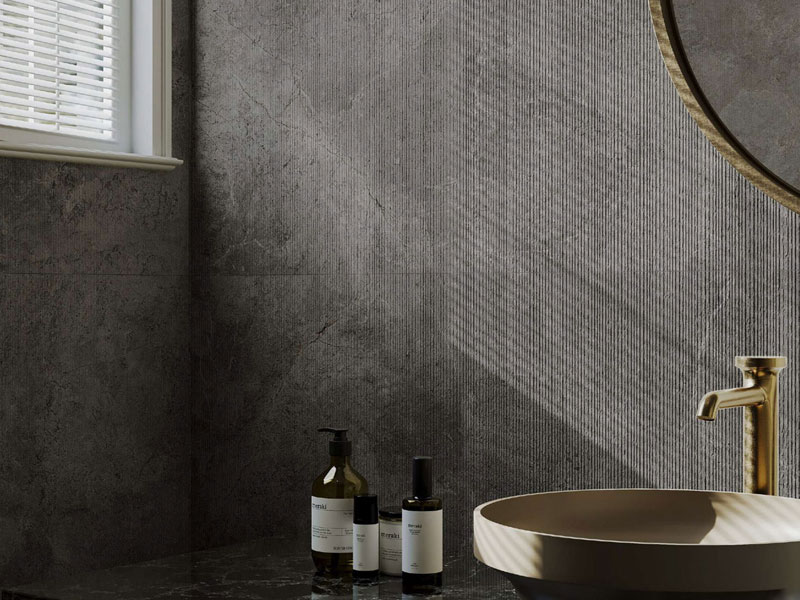
Clean tile lines support a contemporary look
Why Are Warm Neutrals Useful in Contemporary Bathrooms?
Warm beige and ivory tones pair easily with timber, brushed metal and off-white cabinetry.
These tones can also make a bathroom feel softer than a flat cool white scheme while maintaining a clean contemporary character.
The goal is not to make every surface beige. Contrast can still come through texture, black framing, timber or stone movement.
How Can Grey Still Feel Warm?
Grey works best when the undertone is carefully considered.
A cool grey floor paired with cool walls and stainless finishes can feel clinical, while a warmer grey with oak cabinetry, soft lighting or brushed brass creates more balance.
When Should Marble Veining Become the Main Visual Feature?
Strong veining should usually be treated as the dominant movement in the room.
Marvel Shine includes marble-look porcelain tiles and slabs in formats from 300×600 through to 1200×2780, with silk, matt and polished finishes.
When the wall surface is already expressive, the vanity, floor and tapware can remain more restrained.
How Can Modern Bathrooms Use Texture Without Looking Busy?
Texture should add material depth rather than create another competing pattern. Natural stone variation, tumbled edges and subtle relief often feel more integrated than unrelated graphic motifs.
What Is the Difference Between Tonal Variation and Pattern?
Tonal variation changes gradually across the material.
Pattern is more graphic and repetitive.
For premium bathrooms, tonal movement usually creates a calmer result because the surface still reads as one material.
Where Can Natural Stone Add More Depth?
Natural stone works well as a smaller-scale accent or tactile feature.
Athena includes seven natural stones in tumbled square mosaics, subway formats and honed concave 3D mosaics.
These formats can introduce genuine variation around a vanity, niche or feature wall without requiring the entire bathroom to be clad in natural stone.
A similar principle applies across other design categories: when reviewing ceramica tile and design, material character becomes more convincing when texture, scale and surrounding finishes are considered together.
When Are Mosaics Better Than Large Tiles?
Mosaics are useful where smaller scale supports function or detail.
They can suit:
- Shower floors
- Niches
- Curved areas
- Accent zones
- Small feature surfaces
The extra grout should still be considered as part of maintenance and visual rhythm.
How Can a Small Bathroom Feel More Architectural?
Small bathrooms usually benefit from fewer material changes and stronger continuity. The aim is to reduce visual fragmentation rather than fill the room with decorative detail.
Should Small Bathrooms Use Fewer Materials?
Usually, yes.
One main tile can cover most surfaces, while a secondary texture defines one focal area.
This creates depth without making the room feel crowded.
Can One Tile Cover Most Surfaces?
Yes, provided the product is suitable for each intended application.
A continuous stone-look tile can move from floor to wall, while the shower floor may use a smaller compatible format if needed for drainage.
How Can One Feature Surface Add Depth?
Choose one location with a clear architectural role.
Good options include:
- Wall behind the vanity
- End wall of the shower
- Bath wall
- Recessed niche
One concentrated feature usually has more impact than several competing accents.
For homes where material continuity also extends outdoors, the same principle of controlling one dominant surface applies when reviewing pool tile designs: the strongest schemes balance the focal surface with quieter surrounding materials.
How Do Modern Bathroom Tile Strategies Compare?
| Design Strategy | Best Use | Visual Effect | Main Consideration |
| Same tile on floor and walls | Small or minimal bathroom | Strong continuity | Correct finish by zone |
| Large-format stone look | Contemporary bathroom | Calm architectural surface | Set-out and cuts |
| Marble-look feature | Vanity or bath wall | Refined focal point | Control nearby materials |
| 3D textured wall | Selected feature zone | Depth under lighting | Avoid overuse |
| Mosaic accent | Shower or niche | Scale contrast | Grout and maintenance |
| Warm neutral palette | Ensuite or family bathroom | Softer modern character | Undertone coordination |
The best strategy depends on bathroom scale, natural light, joinery and the level of visual emphasis required.
What Bathroom Tile Mistakes Make a Modern Scheme Feel Unresolved?
Most problems come from too many competing surfaces or weak set-out rather than from the tile itself.
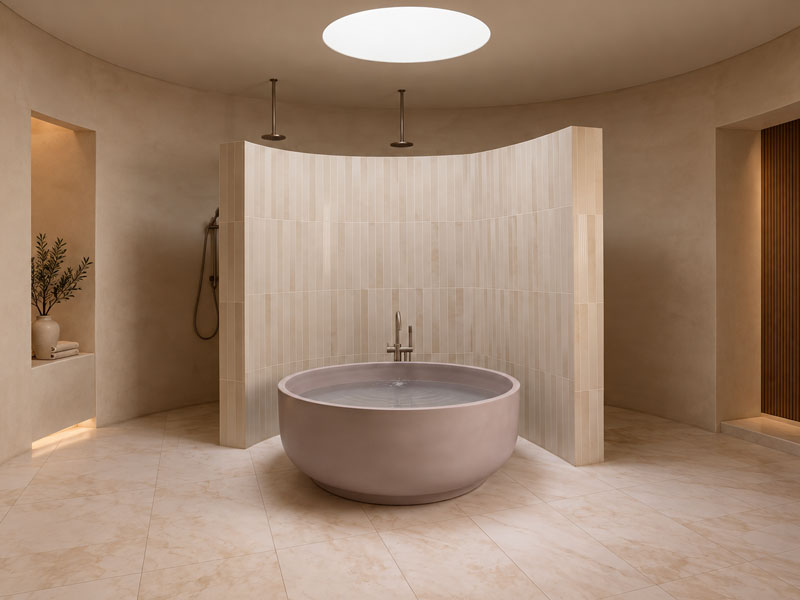
Thoughtful finishes create a cohesive bathroom space
Does Using Too Many Tile Types Reduce Visual Calm?
Yes.
Multiple patterns, strong veining, contrasting grout and different wall colours can make the bathroom feel fragmented.
A smaller number of coordinated materials creates a stronger hierarchy.
Should Every Bathroom Wall Become a Feature?
No.
A feature only works when surrounding surfaces are quieter.
If every wall has strong pattern or texture, the room loses a clear focal point.
Can Poor Set-Out Make Premium Tiles Look Average?
Absolutely.
Awkward narrow cuts, misaligned joints and poorly positioned niches can reduce the impact of high-quality materials.
Should Grout Be Treated as an Afterthought?
No.
Grout controls how visible the tile grid becomes.
A close colour match creates continuity, while stronger contrast makes the module more graphic.
How Can a Bathroom Material Palette Be Built More Deliberately?
A practical sequence is:
- Choose the main architectural surface.
Establish the dominant colour and material character. - Define wet-zone requirements.
Confirm suitable floor and shower finishes. - Add one secondary texture.
Use relief, mosaic or veining strategically. - Coordinate joinery and benchtop materials.
Check undertones together. - Resolve tapware and lighting.
Make sure metals and light temperature support the palette. - Finalise grout and set-out.
Review the tile grid before installation begins.
This process keeps design and performance decisions connected.
Shape a More Architectural Bathroom With Showtile
A refined bathroom is easier to build when floor tiles, wall surfaces and feature materials can be considered as part of one design language. Showtile offers porcelain, natural stone, marble-look and textured collections suited to different bathroom applications and visual directions.
Designers, builders and homeowners can explore the wider Showtile collection to compare materials by format, finish, scale and application rather than selecting each surface separately.
Where several rooms or finishes need to work together, guidance from an experienced designer tiles company can also help narrow the palette and maintain consistency across bathroom floors, walls, joinery and adjoining interiors.
A modern bathroom feels most resolved when the tile layout, surface hierarchy, lighting and surrounding materials are considered as one composition. The strongest result is rarely the room with the most decorative surfaces; it is the room where every surface has a clear purpose.
Contact Showtile
📍 Showroom: 65 Canterbury Road, Bankstown NSW 2200, Australia
📞 Phone: +61 2 9709 5836
✉️ Email: sales@showtile.com.au
🌐 Website: https://showtile.com.au/



