


Bathroom Marble Tiles Design: How to Create a Refined Luxury Space
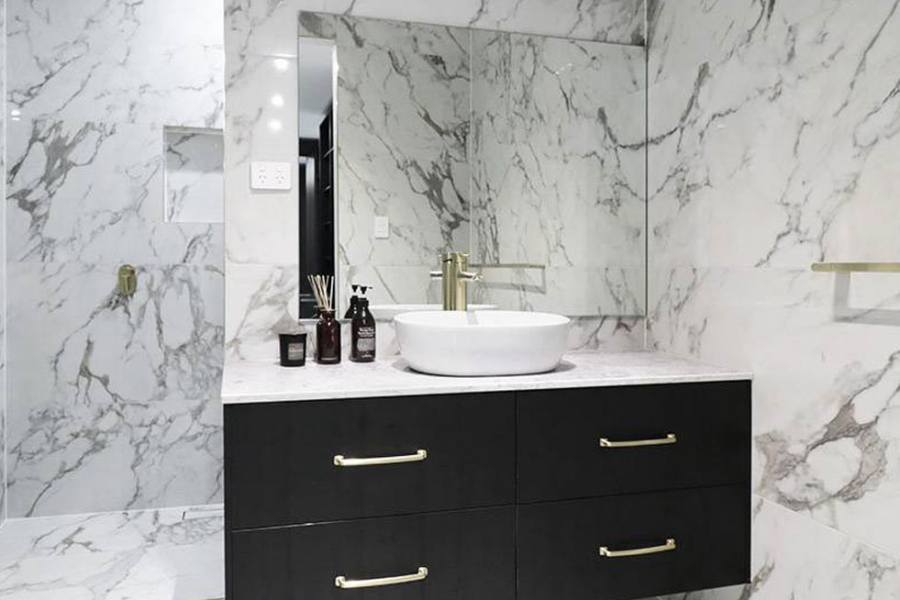
A thoughtful bathroom marble tiles design can create a refined, luxurious space without overwhelming the room. Showtile offers premium marble-look porcelain, large-format surfaces and natural stone mosaics that help homeowners, designers and builders coordinate veining, scale, finish and material balance with confidence.
What Makes a Marble Bathroom Look Refined Rather Than Overdone?
A refined marble bathroom controls visual movement. Strong veining can create a focal point, while quieter marble surfaces work better across larger areas. The goal is to establish hierarchy so the marble feels intentional rather than overwhelming.
Why Does Vein Density Matter in Bathroom Design?
Marble surfaces vary significantly in visual intensity.
A simple way to think about marble movement is:
- Subtle veining for broad wall and floor areas
- Medium veining for balanced premium interiors
- Dramatic veining for feature walls and statement zones
Strong grey or gold veins can become visually dominant when repeated across every surface. A restrained scheme allows the marble to remain the hero material without competing with cabinetry, mirrors and fittings.
How Much Marble Should a Bathroom Use?
There is no fixed percentage, but one or two dominant marble surfaces are often enough.
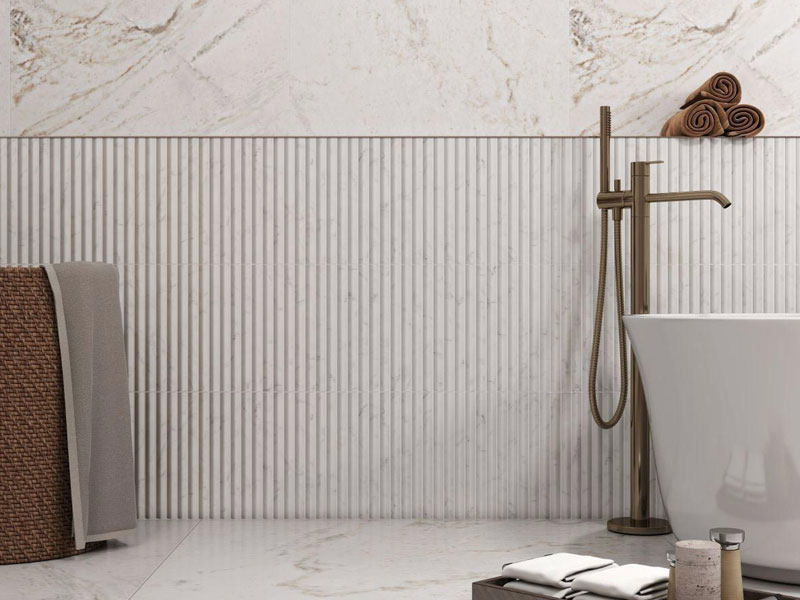
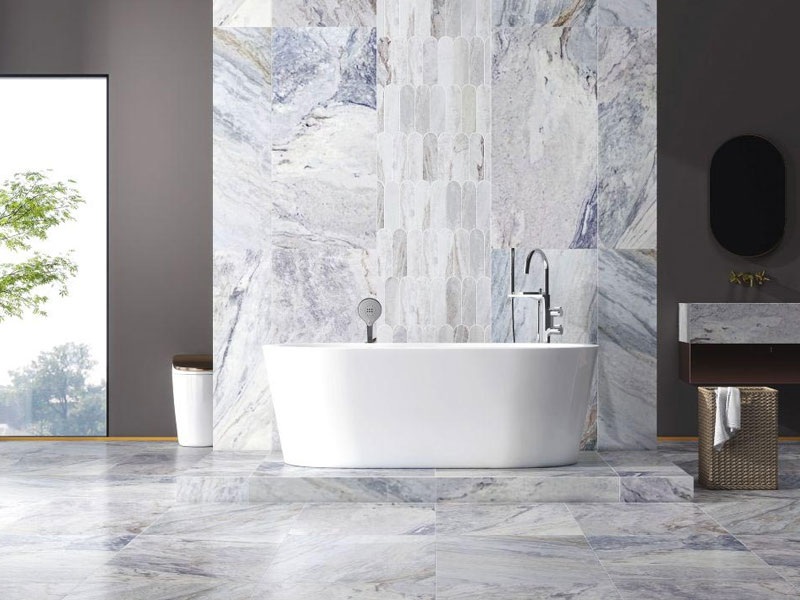
Marble tiles bring timeless elegance to refined bathrooms
Useful combinations include:
- Marble-look floor + plain wall tile
- Full-height marble-look shower wall + neutral floor
- Marble vanity wall + quiet surrounding surfaces
- Porcelain slab wall + natural stone mosaic detail
Material restraint usually creates a more sophisticated result than repeating several unrelated marble types.
Why Does Lighting Change the Marble Appearance?
Lighting affects both background colour and vein intensity.
Warm lighting can soften white marble and highlight gold veining, while cooler lighting may make grey veins appear sharper. Polished surfaces also reflect light more strongly than honed or matt finishes.
Tile samples should therefore be checked under the actual bathroom lighting before final approval.
Should a Bathroom Use Natural Marble or Marble-Look Porcelain?
Both materials can create premium bathrooms, but they offer different advantages. Natural marble provides authentic variation, while porcelain gives greater consistency and easier maintenance.
When Is Marble-Look Porcelain the Better Choice?
Marble-look porcelain tiles work particularly well when the bathroom needs large surfaces, controlled variation and practical everyday performance.
Marvel X is a strong example of this approach, offering Italian-made marble-look porcelain across matt, polished and slab formats.
Porcelain is especially useful for:
- Large shower walls
- Bathroom floors
- Full-height wall applications
- Large-format feature surfaces
- Projects requiring repeated material continuity
Porcelain also allows designers to achieve marble character without relying on the maintenance profile of natural stone.
When Is Natural Marble Worth Considering?
Natural marble tiles are suitable when authentic material variation and tactile character are priorities.
Natural stone works especially well for:
- Vanity splashbacks
- Niches
- Feature walls
- Mosaics
- Small luxury details
Natural marble usually requires more attention to sealing, cleaning and stain prevention. That extra maintenance can be worthwhile when genuine stone character is central to the design concept.
Can Porcelain and Natural Marble Be Combined?
Yes.
One effective strategy is to use porcelain for the large wall or floor surfaces and natural marble for smaller decorative areas. This creates a practical base while preserving the authenticity of real stone in focal zones.
For example:
- Porcelain slab shower wall
- Natural marble mosaic niche
- Porcelain bathroom floor
- Marble vanity detail
Which Marble Look Works Best in a Bathroom?
Different marble families create very different moods. The best choice depends on vein intensity, colour temperature and the supporting materials around the room.
When Does Calacatta Work Best?
Calacatta-style marble generally combines a bright base with stronger grey or gold movement.
Calacatta Oro can create a statement bathroom where gold-vein marble becomes the main visual feature.
Calacatta works particularly well with:
- Brushed brass
- Warm white
- Oak
- Cream
- Soft beige
Because the veining is stronger, Calacatta is often most effective on one or two major surfaces rather than every wall.
When Does Carrara Create a Softer Bathroom?
Carrara-inspired surfaces generally have softer grey movement and a quieter character.
Soft Carrara is well suited to bathrooms where the marble should feel timeless rather than dramatic.
Carrara works effectively across:
- Main floors
- Shower walls
- Vanity walls
- Smaller bathrooms
- Classic or contemporary interiors
This softer visual language makes Carrara easier to combine with timber, chrome and understated cabinetry.
When Does Statuario Feel More Dramatic?
Statuario-inspired marble typically features a bright white base and more defined veining.
Marvel Shine supports this stronger luxury direction with Calacatta- and Statuario-inspired surfaces in wall, floor and large-format applications.
Statuario works best when the surrounding design remains simple. Dark vanity finishes, brushed metal and restrained lighting can make the veining feel more deliberate.
When Do Grey Marble Looks Work Better?
Grey marble looks suit bathrooms that need a more contemporary or less traditional character.
They pair well with:
- Walnut
- Black tapware
- Gunmetal
- Charcoal cabinetry
- Cool white
- Concrete-inspired finishes
For bathrooms built around a broader grey palette, the guide to grey bathroom tiles design provides more detailed guidance on undertones, lighting and warm-versus-cool grey combinations.
How Should Marble Veining Be Oriented in a Bathroom?
Vein direction changes how the eye moves across the room. Planning the direction before installation can significantly improve the final composition.
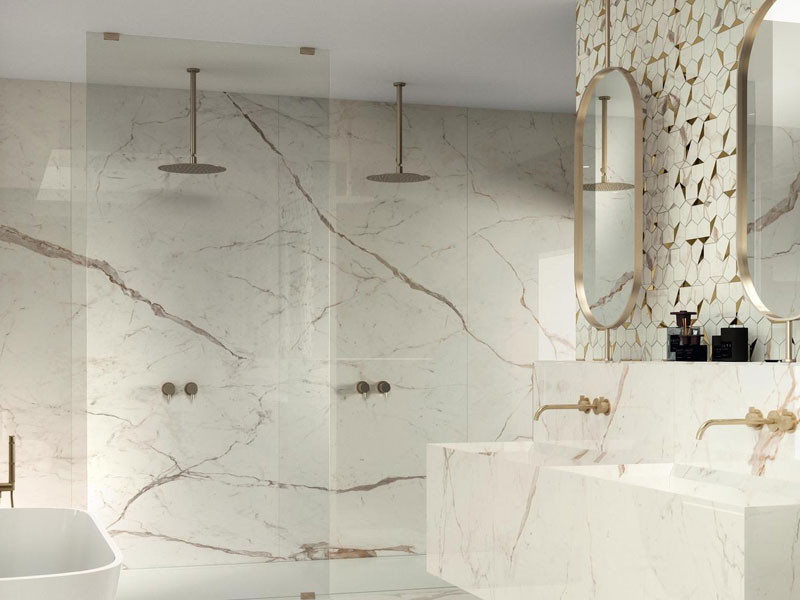
Large-format marble surfaces create seamless visual flow
Should Veins Run Vertically or Horizontally?
Vertical vein direction can:
- Emphasise height
- Strengthen shower walls
- Support tall mirrors
- Create a more dramatic feature wall
Horizontal veins can:
- Emphasise width
- Extend long bath walls visually
- Reinforce horizontal cabinetry
- Make a narrow bathroom feel broader
The best direction depends on room proportion and the dominant architectural lines.
Why Should Veins Be Planned Before Installation?
Random tile placement can interrupt strong marble movement.
Before installation:
- Review multiple tile faces
- Establish a preferred vein direction
- Plan the sequence
- Check corners
- Review cuts around fittings
- Avoid awkward vein breaks
This planning becomes even more important with large-format marble-look tiles.
When Does Bookmatching Work Well?
Bookmatching is most effective when the marble surface is intended to become the main feature.
Suitable locations include:
- Vanity backdrop
- Large shower wall
- Bath wall
- Statement slab installation
Bookmatching can feel excessive in very compact bathrooms, especially when several other patterned materials are already present.
Should Marble Tiles Be Used on the Floor, Walls or Both?
Marble can work across floors and walls, but application should respond to slip performance, maintenance and visual balance.
When Does Marble Flooring Work Best?
Marble-look porcelain is often easier to use across broad bathroom floors because it offers controlled sizing and finish options.
Floor design should consider:
- Slip performance
- Drainage
- Vein direction
- Tile size
- Grout frequency
- Vanity position
For projects where the bathroom floor needs to coordinate with flooring elsewhere in the home, the guide to floor designer tiles explores how premium surfaces, scale and finish can work across different rooms.
When Should Marble Continue From Floor to Wall?
Continuing one marble-look material from floor to wall can create a strong sense of visual continuity.
This approach works particularly well with:
- Large-format porcelain
- Low-contrast grout
- Controlled veining
- Minimal cabinetry
- Simple fixtures
Using one marble family across several surfaces can make the bathroom feel more coherent and expansive.
When Should Marble Stay on One Feature Wall?
Keep marble to one dominant wall when:
- The veining is dramatic
- The bathroom is compact
- The vanity already contains strong stone
- The floor has another visible pattern
- The room has limited natural light
A feature wall can create more impact than covering every surface.
How Should Marble Be Combined With Other Bathroom Materials?
Marble becomes more refined when supporting materials soften or contrast the stone without competing with it.
Why Does Timber Balance Marble So Well?
Timber adds warmth and grain.
Effective combinations include:
- Calacatta + oak
- Carrara + pale timber
- Grey marble + walnut
Timber vanity units are particularly useful when white marble surfaces would otherwise feel too cool.
Which Metals Work Best With Marble?
| Metal Finish | Effect With Marble |
| Brushed brass | Warm and luxurious |
| Chrome | Crisp and classic |
| Brushed nickel | Soft and understated |
| Matte black | Strong visual contrast |
| Gunmetal | Contemporary and tonal |
The metal finish should relate to the marble undertone rather than simply follow a trend.
Should Marble Be Paired With White or Colour?
White creates a timeless and minimal backdrop, but muted colours can create more depth.
Useful supporting colours include:
- Taupe
- Sage
- Warm beige
- Charcoal
- Soft grey
- Cream
One restrained colour is usually enough.
Which Marble Tile Finish Works Best in Bathrooms?
Finish affects both appearance and practical performance.
When Does Polished Marble Look Best?
Polished marble or polished marble-look porcelain works well on:
- Vanity walls
- Feature walls
- Dry wall zones
- Statement surfaces
Polished finishes make veining more vivid and reflect more light.
When Does Honed Marble Feel More Refined?
Honed marble tiles create a softer, less reflective appearance.
Honed surfaces work particularly well in:
- Spa-inspired bathrooms
- Floor applications
- Natural material schemes
- Quiet luxury interiors
The lower reflectivity can make marble feel more tactile and architectural.
When Is Matt Marble-Look Porcelain Better?
Matt porcelain is useful where glare should be reduced or where a quieter stone interpretation is preferred.
Matt surfaces can be especially effective on floors and larger wall areas.
How Should Marble Mosaics Be Used in a Bathroom?
Marble mosaics work best as controlled accents rather than repeated across every surface.
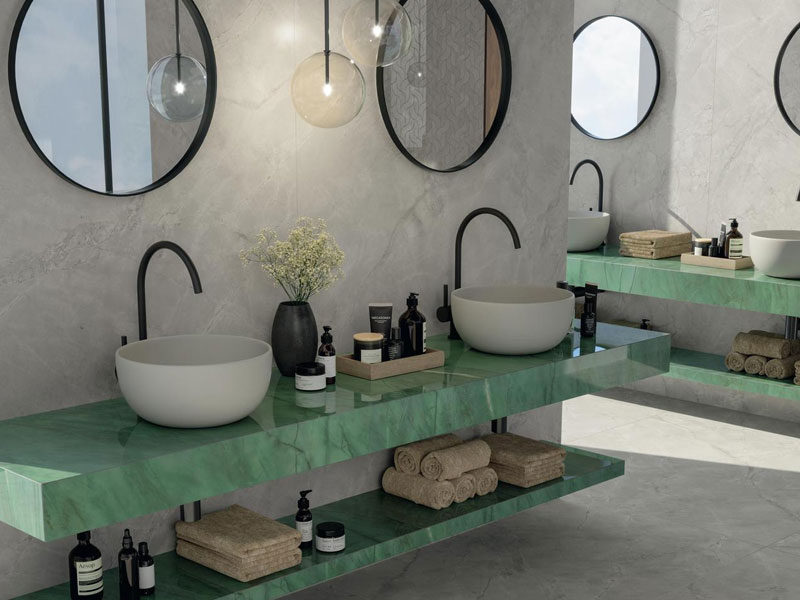
Soft veining adds depth without overwhelming the space
Where Do Carrara Mosaics Work Best?
Carrara Natural Stone Mosaics can bring authentic stone character into smaller zones.
Useful applications include:
- Shower niches
- Vanity splashbacks
- Shower floors
- Decorative wall details
Carrara mosaics are especially effective when the surrounding marble-look tile is more restrained.
When Should Calacatta Gold Mosaics Be Used?
Calacatta Gold Mosaics can create a richer accent through finger, herringbone, hexagon or penny-round formats.
These mosaics work best in small, high-visibility areas where the gold veining can be appreciated without becoming visually heavy.
When Do 3D Marble Mosaics Make Sense?
Vela Marble Mosaic is better suited to dry feature walls or vanity backdrops where dimensional texture can become part of the design.
Three-dimensional marble should usually remain a focal detail rather than a full-room treatment.
How Does Tile Size Change the Marble Effect?
Tile scale determines how continuous the marble movement appears.
Do Large-Format Marble Tiles Look More Luxurious?
Often, yes.
Large tiles reduce grout lines and allow veining to read across broader surfaces.
They are particularly effective for:
- Shower walls
- Bath walls
- Main floors
- Feature walls
However, large formats require more careful substrate preparation, handling and installation.
When Are Medium Formats More Practical?
Medium formats can be better for:
- Compact bathrooms
- Smaller wall planes
- More flexible layouts
- Lower wastage
- Easier cutting
Premium design is not dependent on using the largest available tile.
When Should Porcelain Slabs Be Used?
Porcelain slabs are ideal when the bathroom design requires broad marble movement and minimal grout interruption.
Slabs work particularly well on:
- Full-height shower walls
- Vanity feature walls
- Bath walls
- High-end statement surfaces
Which Marble Bathroom Style Best Fits the Project?
| Design Direction | Recommended Marble Look | Supporting Material | Overall Effect |
| Quiet luxury | Soft Carrara | Oak, brushed nickel | Calm and timeless |
| Statement luxury | Calacatta Oro | Brass, warm white | Rich and expressive |
| Contemporary | Grey marble look | Walnut, black | Refined and modern |
| Spa-inspired | Matt marble-look porcelain | Timber, cream | Soft and relaxed |
| Classic | Carrara marble | Chrome, white | Elegant and familiar |
| Dramatic | Statuario-style veining | Dark vanity | High contrast |
| Boutique hotel | Large porcelain slab | Metal, layered lighting | Seamless and premium |
What Technical Details Matter With Marble Bathroom Tiles?
Visual appeal should never replace technical suitability.
Why Does Slip Performance Matter on Marble-Look Floors?
Bathroom floors need finishes appropriate to wet conditions.
Check:
- Floor suitability
- Surface finish
- Slip performance
- Drainage
- Shower fall
- Grout joints
Polished wall finishes should not automatically be repeated on wet floors.
Why Does Natural Marble Need More Maintenance?
Natural marble generally requires more care than porcelain.
Maintenance may include:
- Sealing
- pH-neutral cleaning
- Stain prevention
- Avoiding harsh chemicals
- Monitoring surface wear
This should be considered before choosing natural stone for high-use areas.
Why Should Marble Samples Be Viewed Together?
Marble variation can be significant.
Compare several pieces together to review:
- Vein intensity
- Background colour
- Undertone
- Pattern direction
- Lighting response
For buyers developing a broader premium material palette, working with a specialist designer tiles company can help coordinate marble surfaces with joinery, floor finishes and other architectural materials.
What Should Be Checked Before Ordering Marble Bathroom Tiles?
Before confirming quantities:
Create a Refined Marble Bathroom With Showtile
- Choose natural marble or porcelain.
- Select one main marble family.
- Review vein density.
- Confirm wall or floor suitability.
- Select the finish.
- Check wet-area performance.
- Test tile scale against the room.
- Plan vein direction.
- Choose the feature wall.
- Select grout colour.
- Compare tapware finish.
- Review vanity material.
- Check samples under bathroom lighting.
- Add wastage.
- Keep spare tiles where practical.
Where a marble feature sits directly behind a toilet or vanity, the more specific principles covered in toilet wall tiles design can help refine wall hierarchy, feature placement and fixture alignment.
Which Showtile Collections Suit Marble Bathroom Designs?
Showtile’s tile collection offers several marble directions, from quieter Carrara-inspired porcelain to stronger Calacatta and Statuario surfaces.
Useful options include:
- Marvel X for versatile marble-look porcelain and slabs
- Soft Carrara for understated grey-vein marble character
- Calacatta Oro for warmer gold-vein luxury
- Marvel Shine for brighter statement surfaces
- Carrara Natural Stone Mosaics for authentic accent details
- Calacatta Gold Mosaics for decorative focal zones
- Vela Marble Mosaic for dimensional marble feature walls
The strongest choice should reflect vein intensity, surface role and practical bathroom requirements rather than selecting the most dramatic marble by default.
Create a Refined Marble Bathroom With Showtile
A sophisticated marble bathroom depends on balance rather than maximum visual impact. Marble type, vein direction, tile scale, finish and supporting materials should work together so the bathroom feels cohesive and considered.
Explore Showtile to compare marble-look porcelain, large-format surfaces and natural stone mosaics for refined residential and commercial bathroom projects.
Contact Showtile
📍 Showroom: 65 Canterbury Road, Bankstown NSW 2200, Australia
📞 Phone: +61 2 9709 5836
✉️ Email: sales@showtile.com.au
🌐 Website: https://showtile.com.au/



